
Introduction
If you’ve used ChatGPT, seen a self-driving car, or noticed how Netflix recommends the perfect movie, you’ve encountered Artificial Intelligence (AI). But what exactly is AI? How does it work under the hood? And how did we get from simple calculators to bots that write poetry, code, and hold conversations?
This beginner’s guide will take you from zero knowledge to understanding the core ideas behind AI, machine learning, deep learning, and the Large Language Models (LLMs) making headlines today. You don’t need a math or programming background — we’ll use analogies, visuals, and plain language.
By the end, you’ll be able to explain terms like “neural network,” “training,” and “transformer” to your friends. Let’s demystify AI together.
Note: This guide is for understanding, not building production models. No code required (but a simple example is included for curiosity).
Understanding the Purpose of AI
Why do we even need AI? The purpose is to automate tasks that normally require human intelligence. Think of AI as software that learns patterns rather than following fixed rules.
From Hard-Coded Rules to Learning
Traditional software is like a recipe: you give exact instructions, and the computer follows them perfectly. If you want a program to recognize a cat, you’d have to write rules like “if object has pointy ears and whiskers, then it’s a cat.” But what about hairless cats? Or a cat from the side? The rules quickly break.
AI solves this by learning from examples. Instead of programming rules, you show the AI thousands of cat photos (and non-cats), and it figures out the patterns by itself. This is called machine learning — the core of modern AI.
Why Now? The Three Drivers
AI has existed since the 1950s, but exploded recently due to three factors:
- Data – The internet gave us huge amounts of text, images, and videos.
- Compute – GPUs (graphics cards) can process massive calculations in parallel.
- Algorithms – Better mathematical techniques, especially deep learning and transformers.
Compounding Improvements in AI
Like compound interest in investing, AI models build on each other. A slightly better model today enables even better models tomorrow. The progress from GPT-2 to GPT-4 happened in just a few years.
Illustrative growth of AI capabilities over time.
Determining Your Learning Approach
Before diving into AI concepts, consider your goals. Unlike investing, AI learning doesn’t involve risk — but it does involve time and mental energy.
Set Your Learning Goals
Ask yourself:
- Do I want to use AI tools effectively? (e.g., prompt engineering, knowing limitations)
- Do I want to understand how AI works conceptually? (enough to follow news and make decisions)
- Do I want to build AI models? (requires programming and math)
Most people benefit from the first two. This guide focuses on conceptual understanding.
Assess Your Time and Math Comfort
- No math background – You can still understand high-level ideas: patterns, training, inference.
- High school math (basic algebra) – You can grasp neural networks as weighted sums.
- Calculus/linear algebra – You can dive into backpropagation and deep learning details.
Align Your Strategy
For beginners: start with analogies, avoid jargon, use interactive demos (like Google’s Teachable Machine). Then move to articles, videos, and finally lightweight technical explanations.
Core Concepts: From AI to LLMs
We’ll build up from the simplest ideas to today’s large language models. Think of it as layers of a pyramid:
- Artificial Intelligence (AI) – The broad field: making machines intelligent.
- Machine Learning (ML) – A subset: learning from data.
- Deep Learning – ML using many-layered neural networks.
- Large Language Models (LLMs) – Deep learning models trained on massive text.
Artificial Intelligence – The Umbrella
AI is any technique that enables computers to mimic human intelligence. This includes old-school methods like decision trees, expert systems, and search algorithms (e.g., chess engines). Modern AI is almost synonymous with machine learning.
Machine Learning – Learning from Examples
Instead of explicit rules, ML algorithms find patterns in data. There are three main types:
- Supervised learning: You provide input-output pairs (e.g., images labeled “cat” or “dog”). The model learns to map inputs to outputs.
- Unsupervised learning: Only inputs, no labels. The model finds hidden structure (e.g., grouping customers by behavior).
- Reinforcement learning: An agent learns by trial and error, receiving rewards or punishments (e.g., AlphaGo).
Most LLMs use a mix: they are trained with self-supervised learning (predict the next word in a sentence, no human labels needed).
Neural Networks – The Building Block
Inspired (very loosely) by the brain, a neural network consists of layers of “neurons.” Each neuron takes inputs, multiplies them by weights (strength of connection), sums them up, and passes through an activation function.
A simple neuron can learn simple patterns. Stack many layers, and you get deep learning — capable of recognizing faces, understanding sentences, and more.
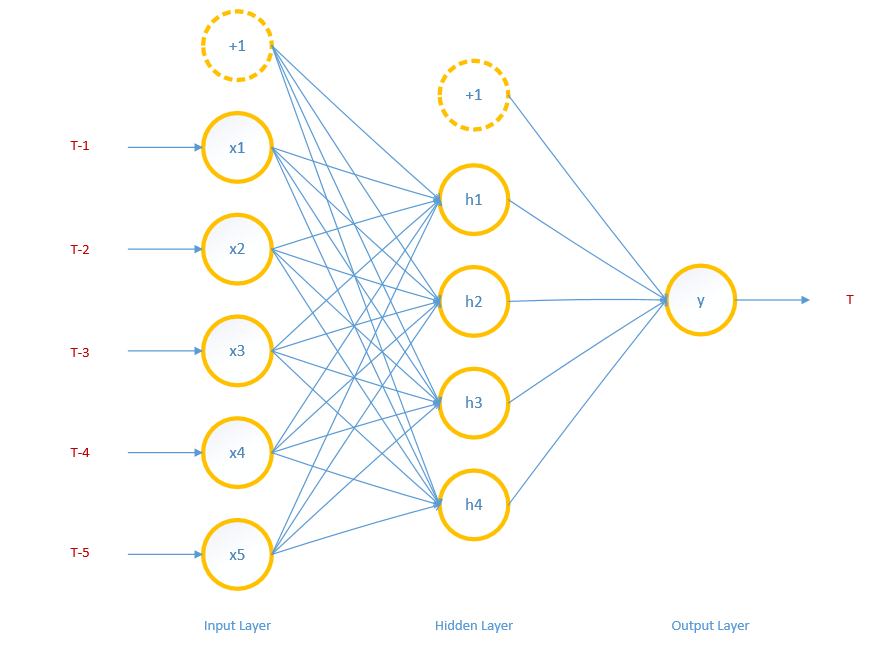
A tiny neural network with 1 hidden layer. Modern LLMs have hundreds of layers and billions of neurons.
How Neural Networks Learn (Training)
Training is the magic step. You show the network examples, compare its prediction to the correct answer, and adjust the weights slightly to reduce the error. Repeat millions of times. The algorithm that does this is called backpropagation (backward propagation of errors).
Think of it like tuning a guitar: you pluck a string, hear if it’s too high or low, turn the peg a bit, and repeat until it’s perfect. The network automatically does this for millions of “strings” (weights).
Large Language Models (LLMs) – The Revolution
LLMs are a type of neural network designed for text. They use a special architecture called Transformer (introduced by Google in 2017). Transformers process words in parallel (not one after another) and use “attention” to focus on relevant parts of the input.
Key properties of LLMs:
- Trained on enormous text (internet, books, Wikipedia, code).
- Objective: predict the next word (or masked word) in a sequence.
- Emergent abilities: after a certain size, they can translate, summarize, write code, reason step-by-step — abilities not explicitly taught.
- Examples: GPT-4 (ChatGPT), Claude, Gemini, Llama.
How ChatGPT Generates Text
To move from these foundations to current deployment choices, read my detailed comparison of open-source and open-weight AI models in 2026, including capabilities, licenses, hardware requirements, and learning resources.
To understand how models connect to tools and complete multi-step tasks, continue with my practical guide to AI agents, MCP, and workflows.
When you give a prompt, the model looks at all previous words and predicts the most likely next word, then adds that word, and repeats. It’s like advanced autocomplete. The “temperature” parameter controls randomness: low temperature = more focused/predictable; high temperature = more creative.
Developing Your AI Literacy Strategy
You don’t need to build an LLM to understand them. Here’s a practical learning path.
Start with Conceptual Analogies
- Neural network weights = knobs that adjust sensitivity to different features.
- Training = learning to ride a bike (falling, adjusting, improving).
- Attention mechanism = when reading a sentence, you focus on certain words more than others.
Experiment with Free Tools
- ChatGPT, Claude, or Gemini – try different prompts.
- Google’s Teachable Machine – train a simple image classifier in your browser.
- Hugging Face – demo thousands of models without code.
Follow the News but Stay Critical
AI hype is real. Ask: Is this a genuine breakthrough or incremental improvement? What data was it trained on? What biases might it have?
Understand Limitations
LLMs have several weaknesses:
- Hallucinations – they confidently produce false information.
- Bias – they amplify biases in training data.
- No true understanding – they are pattern matchers, not reasoners (though debate continues).
- Static knowledge – most have a knowledge cutoff date (e.g., GPT-4 up to April 2023 unless browsing).
Managing Your AI Knowledge (Like a Portfolio)
Just as an investment portfolio needs diversification and rebalancing, your AI understanding needs regular updates and critical evaluation.
Stay Up-to-Date (But Avoid Burnout)
AI moves fast. Follow a few reliable sources:
- Newsletters: Import AI, The Batch (DeepLearning.AI)
- Podcasts: Lex Fridman (interviews), Machine Learning Street Talk
- Twitter/X: Follow researchers (@karpathy, @hardmaru, @ylecun)
Re-evaluate Your Mental Model
Every few months, check if your understanding still holds. For example, in 2022, many thought LLMs couldn’t do basic math; now they can (with tools). Update your conceptual models as the field evolves.
Beware of Anthropomorphism
It’s tempting to say “the AI thinks” or “the AI wants.” Remember: LLMs are next-word predictors. They don’t have desires, consciousness, or beliefs. This is crucial for using them responsibly.
Conclusion
Artificial Intelligence, from its rule-based origins to today’s astonishing Large Language Models, is a transformative technology. You don’t need a PhD to understand the basics: AI learns patterns from data, neural networks are the workhorses, and LLMs use the transformer architecture to handle language.
Key takeaways:
- AI automates tasks that typically require human intelligence.
- Machine learning learns from examples instead of explicit rules.
- Deep learning uses layered neural networks.
- LLMs are deep learning models trained on massive text to predict words.
- They are powerful but have limitations (hallucinations, bias).
Encouragement to Start Learning Today
You can start right now: open ChatGPT, ask it “Explain neural networks to a 10-year-old,” and see what happens. Then try the same question with a different prompt. Experimentation is the best teacher.
When to Seek Expert Guidance
If you decide to build AI systems, consider formal courses (Andrew Ng’s CS229, Fast.ai) and learn Python, linear algebra, and calculus. For most people, conceptual understanding plus hands-on prompting is enough.
Final Thought
AI is a tool, not a magic wand. The best way to use it is to understand its strengths and weaknesses. Now go forth and prompt!
Resources
Books for further reading

By: Brian Christian
By: Max Tegmark
By: Ian Goodfellow
Videos for further explanation
 Google’s AI Course for Beginners
 Artificial Intelligence Full Course
 But what is a neural network? | 3Blue1Brown
Interactive Websites & Courses
Google's Machine Learning Crash Course
https://developers.google.com/machine-learning/crash-courseFree interactive course with video lectures and exercises.
Fast.ai - Practical Deep Learning
https://www.fast.aiHands-on course that teaches you to build AI models from the top down.
DeepLearning.AI (Andrew Ng)
https://www.deeplearning.aiWorld-famous courses on ML and deep learning (some free).
| Title | Link | Description |
|---|---|---|
| Google's Machine Learning Crash Course | https://developers.google.com/machine-learning/crash-course | Free interactive course with video lectures and exercises. |
| Fast.ai - Practical Deep Learning | https://www.fast.ai | Hands-on course that teaches you to build AI models from the top down. |
| DeepLearning.AI (Andrew Ng) | https://www.deeplearning.ai | World-famous courses on ML and deep learning (some free). |
| ChatGPT by OpenAI | https://chat.openai.com | Try the most popular LLM yourself. |
Simple Code Example (Python)
# Simple example: a tiny neural network in Python using NumPy
import numpy as np

# Activation function (sigmoid)
def sigmoid(x):
    return 1 / (1 + np.exp(-x))

# A single neuron with 3 inputs, random weights
weights = np.random.randn(3)
input_data = np.array([0.5, -0.2, 0.1])

# Forward pass: sum of (inputs * weights) then activation
z = np.dot(input_data, weights)
output = sigmoid(z)

print(f"Neuron output: {output:.4f}")