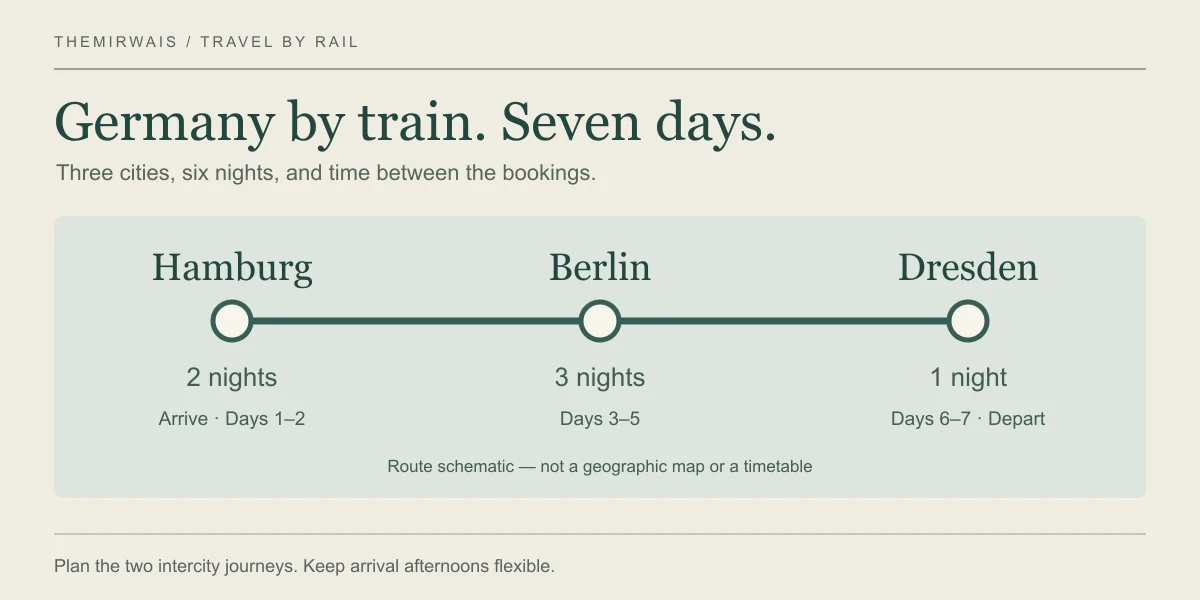
A seven-day trip can look wonderfully simple on a map: a few cities, two train journeys, plenty of time. Then you add the station transfer, hotel check-in, a bag that needs storing and a museum booking that cannot move. Suddenly the afternoon is much shorter.
The way to enjoy Germany by train is to leave room for those ordinary details. This route links Hamburg, Berlin and Dresden in seven days, with just two hotel changes. It gives you a harbour city, several days in the capital and a final stop beside the Elbe, without trying to fit Bavaria into the same week.
Book two nights in Hamburg, three in Berlin and one in Dresden. Arrive on day one and leave on day seven. That is six nights, not seven. The plan ends in Dresden; a return to your arrival city needs additional travel time and a separate budget.
The day plans below are suggested combinations, not a diary of a trip I took. Rail and attraction information was checked on October 26, 2026. Use the linked operators for your actual dates: construction, seasonal hours and admission rules can change.
The seven-day Germany rail itinerary at a glance
| Day | Base that night | Main plan | What to keep flexible |
|---|---|---|---|
| 1 | Hamburg | Arrive, settle in, explore the centre or waterfront | Everything after the arrival journey |
| 2 | Hamburg | Speicherstadt, HafenCity and one booked attraction | Harbour time if the weather turns |
| 3 | Berlin | Train to Berlin, then the government district | A timed visit immediately after the train |
| 4 | Berlin | Berlin Wall Memorial and a neighbourhood afternoon | The indoor/outdoor balance |
| 5 | Berlin | One museum or special-interest visit, then a slower afternoon | A third major attraction |
| 6 | Dresden | Train to Dresden, Old Town and the riverside | Interior visits until you know arrival time |
| 7 | — | A short final walk or visit, then depart | Anything that threatens the onward connection |
On a phone, scroll the table sideways. The route is deliberately selective. If your main interests are Alpine scenery or Bavarian castles, choose a southern itinerary instead of adding another long transfer to this one.
How long are the train journeys?
At the research check, DB listed direct Hamburg Hbf–Berlin Hbf services around 1 hour 48 minutes, and direct Berlin Hbf–Dresden Hbf examples around 1 hour 39 minutes. These are timetable examples, not fixed journey times. Check Hamburg–Berlin on DB and Berlin–Dresden on DB for your departure date.
The useful number for planning is longer than the train ride. Include the journey to the station, time to find the platform, your arrival transfer and whatever happens to your luggage before check-in. Treat each intercity move as part of a travel day, even when the train itself takes under two hours.
Days 1–2: Hamburg without rushing the harbour
Day 1: arrive, unpack, and keep one simple plan
Use your first afternoon to get settled. If you have the energy, choose either a centre-and-Alster walk or some time along the harbour. There is no prize for reaching both before dinner.
Staying near a useful public-transport connection matters more than the hotel’s straight-line distance from Hamburg Hbf. Check the route with luggage, the final walk from the stop and the arrangements for an early arrival. A cheap room becomes less appealing if it adds an awkward transfer every time you go out.
If you arrive late, let day one be an arrival day. The route still works. Moving a paid attraction into the evening simply to fill the timetable can turn an ordinary delay into a missed booking.
Day 2: Speicherstadt, HafenCity, and one anchor booking
Group Speicherstadt and HafenCity together, then choose a main visit. Miniatur Wunderland is an option if miniature worlds interest you; the Elbphilharmonie Plaza offers a different kind of stop. You can see more, but choose the booking you care about before building the rest of the day around it.
Miniatur Wunderland’s own booking page explains its entry windows and recommends advance booking to avoid waiting. Use the slot you actually secure, rather than assuming the attraction will fit a spare hour.
For the Elbphilharmonie Plaza, check the current ticket category and admission charge. Older advice about unrestricted free access can be out of date. A Plaza visit is also different from attending a concert: book the experience you mean to have.
Leave the remaining time for the waterfront, a meal and a break. My weekend in Hamburg guide gives more ideas for the harbour, Alster and individual sights. Treat its attractions as choices for these two days rather than a list you must complete.
Days 3–5: give Berlin enough room
Day 3: take the train, then stay in one part of the city
Choose a Hamburg–Berlin departure that leaves time for breakfast and the station transfer. After arriving, deal with luggage before starting the sightseeing. “We will find somewhere for the bags” is a surprisingly effective way to lose an hour.
For the afternoon, keep the government district and Brandenburg Gate as the main area. You can walk, take public transport between stops, or shorten the route depending on your energy. Berlin rewards grouping places by area; a list sorted by fame can send you back and forth across the city.
If you want the Reichstag dome, use the Bundestag’s official registration information. Admission is free but registration is required, and closures can affect the dome separately from the roof terrace. Read the current closure notice for your dates before requesting a slot.
Place a confirmed visit on a day when you can reach it comfortably. If only a tight post-train slot is available, decide whether it is worth that risk.
Day 4: understand the Wall before adding more landmarks
Start with the Berlin Wall Memorial on Bernauer Straße. It gives the history a physical setting, rather than reducing the Wall to a quick photograph. The Berlin Wall Foundation’s visitor map helps you identify the memorial grounds, Visitor Center and Documentation Center. Check the individual buildings’ hours before choosing your day.
Keep the afternoon open for a neighbourhood you want to spend time in. A café, a bookshop, a market if one is operating, or simply a meal without a train to catch can be enough. You do not need another major site to justify the afternoon.
If you also want the East Side Gallery, recognise it as a separate stop with its own journey. Adding it is reasonable; treating it as if it were next door to Bernauer Straße is less so.
Day 5: choose the museum you actually want to see
Use this as your main museum or special-interest day. Pick a collection, exhibition or guided visit that interests you, check its own opening calendar and give it enough time. Do not buy a multi-attraction pass before checking which places you will realistically enter.
Keep the later part of the day loose: a park if the weather is pleasant, another part of the city, or a second indoor stop if you still want one. This is also where the itinerary can absorb something that moved because of rain or a closure.
Berlin has three nights here because arrival logistics and distances matter. If you prefer a slower trip, you can stop the route in Berlin and spend the Dresden night there instead. You would lose a city and gain time; that can be a good exchange.
Days 6–7: Dresden’s centre and the Elbe
Day 6: arrive, then give the Old Town an afternoon
Travel from Berlin to Dresden and choose the arrival station that fits your accommodation. Dresden Hbf and Dresden-Neustadt are different stations. A familiar city name in the search results does not mean the same final walk to your hotel.
After leaving your bags, make the Old Town and riverside the focus. The Frauenkirche, the Zwinger area and Brühl’s Terrace form a useful set of places to choose between. The official Dresden Elbland sights guide links the main attractions and their visitor information. Choose any interior visit according to its actual opening time and ticket availability.
Do not assume that walking past a building, entering it and seeing its collections are the same visit. If you want a substantial museum session, protect that time and shorten the outdoor route. For a lighter afternoon, leave interiors for another trip and spend longer beside the river.
Day 7: match the morning to your departure
If the onward journey leaves late enough, take a short walk or choose one final visit. Crossing towards Neustadt gives a different perspective from staying entirely in the Old Town. Keep the route easy to cut short.
If you need to return to Berlin or Hamburg for a flight, day seven may mainly be a transport day. Price and schedule that return before committing to hotels. For an early flight, consider sleeping near the departure point the previous night, which means changing this six-night allocation.
This itinerary does not include an airport transfer or a return rail leg in its two intercity journeys. Those details belong in your plan as soon as you know where the trip really ends.
Which German train tickets should you buy?
Start with the two intercity journeys, then work out local travel. Buying a pass first and designing a trip to justify it reverses the useful order.
Individual long-distance tickets
DB’s saver-fare information explains the train-specific conditions of Sparpreis fares. The Super Sparpreis page describes a more restrictive cancellation policy, including the limited instant-cancellation provision. Read the fare conditions before paying, especially when the train follows a flight or another uncertain arrival.
A flexible fare offers different freedom within its validity and route conditions. Compare what that freedom is worth for the journey you are booking. It does not mean any train, anywhere, on any date.
Enter the real start and end points in your search. If you need local travel before or after the main train, check whether it appears on the ticket and whether any City-Ticket is included or charged separately. A ticket between central stations is not automatically a day pass for sightseeing.
Deutschland-Ticket: useful locally, different from an ICE ticket
The Deutschland-Ticket’s service rules cover participating local and regional transport. It is generally not valid on ICE, IC or EC services, apart from specifically designated exceptions. This route assumes separate tickets for its long-distance legs.
It is also a subscription, not a rolling seven-day tourist pass. DB describes validity by calendar month and its subscription and cancellation terms. A week spanning two months or a purchase after a cancellation deadline can change the total cost. Compare that total with local tickets before subscribing.
Rail passes: compare two travel days with the whole price
This route has two main intercity travel days. Write down the fares for your preferred departures, then compare a suitable pass’s price, reservation costs, eligibility and coverage. Local transport may still need separate tickets. Check the actual pass conditions; different products are not interchangeable.
A pass can be useful when flexibility matters or when you add substantial rail travel. That does not make it the default answer for every week-long trip. Two inexpensive advance fares and two last-minute flexible fares are very different comparisons.
Seats, luggage, connections, and accessibility
A ticket gets you the travel entitlement described in its conditions. A seat reservation deals with a particular seat. Use DB’s reservation information, and check what your selected fare includes. Do not assume a second-class long-distance ticket automatically comes with a reserved seat.
For a busy departure or a group that wants to sit together, consider reserving. The extra planning can also help you decide where to place bags and whether the carriage suits your needs. International services can have different reservation requirements.
Pack what you can handle through a station yourself. DB’s luggage guidance explains storage and keeping aisles, doors and designated spaces clear. A compact bag can be easier than a large suitcase when a platform changes or an escalator is unavailable. Keep essentials, tickets and medication accessible rather than buried in the largest bag.
If you need boarding assistance, step-free access or more time to change trains, plan that before purchasing an awkward connection. DB’s Mobility Service Centre information explains assistance arrangements and registration. Check the particular stations and trains; “travelling by rail” is not itself a promise of step-free access at every point.
On travel days, recheck the departure, platform and final destination in the operator’s live information. Keep a usable ticket and ID available even if mobile reception or your battery becomes a problem. A screenshot can help you remember details, but it is not a universal substitute for the ticket format the operator requires.
Leave room for a late train
Keep timed attractions away from a narrow arrival window. Direct services remove a change, but they do not remove disruption risk. If you do need a connection, choose transfer time that fits your mobility and luggage, rather than simply the shortest option shown.
When something goes wrong, consult DB’s passenger-rights guidance and ask the operator about your ticket. Do not assume you can take any replacement train. Separate local and long-distance tickets can create separate contracts, particularly when combining a Deutschland-Ticket with a train-specific fare. Keep the relevant tickets, notices and receipts.
A sample budget you can replace with real quotes
Here is a hypothetical planning worksheet, not a survey of current prices. It assumes two adults sharing one room for six nights, seven food-budget days, and separate tickets for two intercity journeys. Replace every assumption with quotes for your dates, including mandatory accommodation taxes and fees.
| Cost per person | Illustrative calculation | Amount |
|---|---|---|
| Accommodation | 6 nights × €120 per room ÷ 2 people | €360 |
| Food | 7 days × €35 | €245 |
| Intercity trains | 2 journeys × €35 | €70 |
| Local transport | Assumed total for the chosen tickets | €35 |
| Admissions | Assumed total for selected visits | €60 |
| Contingency | An illustrative allowance | €80 |
| Total | Per person, under these assumptions | €850 |
The room figure is a made-up, tax-inclusive input, not a promise of availability. If one person pays the full room cost at the same assumed rate, the accommodation line becomes €720 and the total becomes €1,210. If a particular hotel quotes more, the worksheet should show more.
Travel to Germany, the journey home, airport transfers, an extra return rail leg, insurance and personal purchases are excluded. A contingency allowance cannot guarantee that every disruption is covered. Compare the complete trip cost, including cancellation conditions, rather than treating the €850 scenario as an advertised package.
For a broader look at keeping unexpected costs separate from money already committed, my emergency-fund guide explains that distinction. For this trip, an unpaid hotel bill still belongs in the planned cost column.
Adapt the route before adding another city
In warmer months, you may want more outdoor time; in darker or wetter periods, choose an indoor anchor and a shorter walk. Actual weather matters more than the month printed on the calendar. Check opening days before assigning a museum to a Monday or a holiday.
With children, favour fewer timed bookings and a meal break before a long station transfer. With limited walking stamina, group one area at a time and price the local transport that makes it workable. Neither adjustment needs a separate list of twenty attractions.
If you arrive late on day one and leave early on day seven, you have five usable sightseeing days, not seven full ones. Removing Dresden is the cleanest simplification. If Dresden is the main reason for the trip, shorten Hamburg or reverse the route to fit your actual transport connections.
Before booking, confirm the six-night accommodation plan, the two intercity departures, any necessary return journey and the handful of visits you would regret missing. Keep a few uncommitted hours. They are useful when plans change, and just as useful when you find somewhere you would rather stay longer.
Books, videos, and official planning resources
Select Read More for the Book and Author tabs. Buy opens the publisher’s page; edition details, prices and availability vary. The books offer route and destination context, while current operators and venues govern tickets and admission.
Books

Videos you can watch here
Use a play button to watch within the site. The recordings below introduce the destinations; their descriptions give the recording or publication context. Use the current links in this guide for practical details that may have changed since filming.
 Is Hamburg Really as Impressive as on Instagram? — DW Travel
 Berlin — Rick Steves' Europe
 Dresden: 6 Reasons for Visiting the Fascinating Baroque City — DW Travel
Official links to use before booking
- DB tickets and offers — compare ticket types for your journeys.
- Deutschland-Ticket — current subscription terms and price.
- DB seat reservations — check the reservation separately from the fare.
- DB passenger rights — guidance when a service changes or is disrupted.
- Elbphilharmonie Plaza — current admission and visitor information.
- Miniatur Wunderland booking — entry slots and availability.
- Bundestag visitor registration — registration and dome closures.
- Berlin Wall Memorial — the site, exhibitions and visit planning.
- Dresden Elbland sights — official links to the city’s attractions.