You have some money left after payday. Your savings account feels too small, but leaving the money there means postponing an investment. Every choice seems to come with a cost.
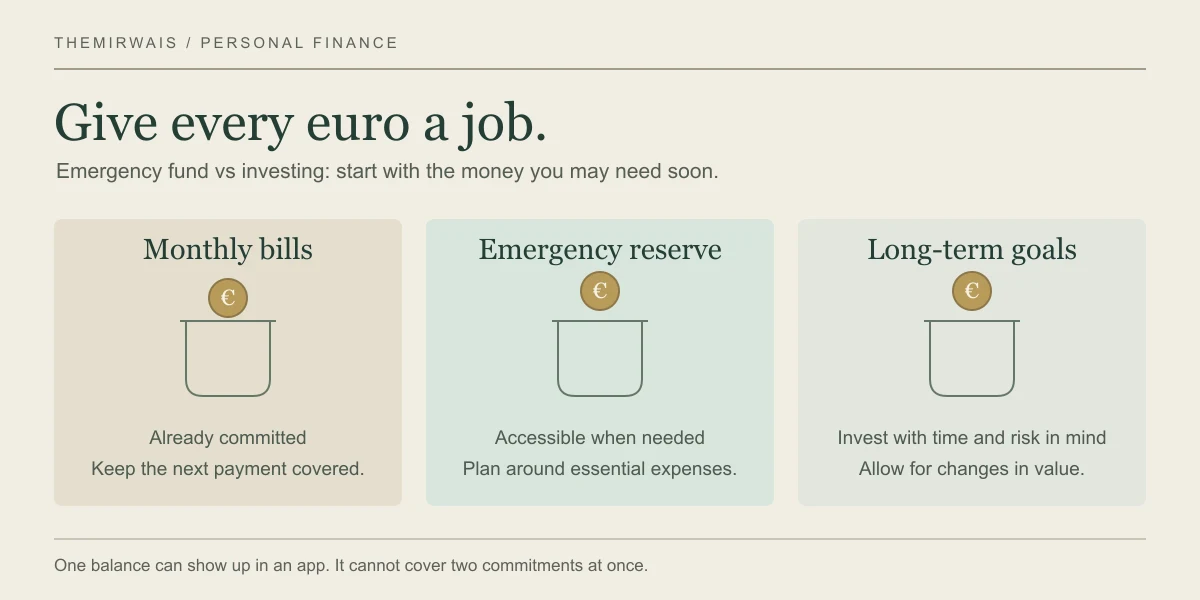
The emergency fund vs investing question becomes easier when you give the money a specific job. Cash pays a bill when the timing is inconvenient. Long-term investments take risk in pursuit of future growth. Asking the same money to do both can leave you selling an investment just to get through the month.
Start by working out the essential expenses you would still have during an income disruption. Use that figure to set a cash target, then decide what you can invest without needing it back at short notice. The target will depend on your household; a round number borrowed from someone else’s budget is a poor substitute.
This is general financial education, not a personal investment or tax recommendation. The euro amounts below describe a fictional household. Sources and deposit-protection guidance were checked on October 26, 2026; local rules, eligibility and account terms still need checking.
Emergency savings and investments solve different problems
An emergency fund is money reserved for expenses or income interruptions your normal budget cannot absorb. The Consumer Financial Protection Bureau’s emergency-fund guide explains its role in handling financial shocks and avoiding a cycle of borrowing. Even a modest reserve can help with a modest bill.
Long-term investing serves a different purpose. You accept uncertainty about the value along the way because the goal is further off. That uncertainty matters less when you have flexibility over when to sell, and much more when rent is due on Friday.
| Money’s job | A useful question | What to look for |
|---|---|---|
| Pay this month’s bills | Has the next rent payment already been accounted for? | Reliable payment access and enough operating cash |
| Cover an unexpected disruption | What happens if pay stops or an urgent repair arrives? | An accessible reserve with understandable protection |
| Pay a known future bill | How much is due, and when? | Separate planned savings matched to the deadline |
| Fund a long-term goal | Can I leave this money invested through a fall? | A suitable investment plan, diversification and manageable costs |
On a small screen, scroll the table sideways. These categories are bookkeeping tools: you do not need four different banks or a complicated app. You do need to avoid counting the same balance twice.
If investing terminology is new, Investment 101 introduces asset classes, diversification and portfolio planning. This article deals with the cash decision that sits alongside those choices.
How much emergency fund do you need?
Three to six months of essential spending is a familiar starting range. MoneyHelper uses that rule of thumb for a readily accessible reserve. It is guidance, rather than proof that month three is sufficient or month seven is excessive.
Notice the word spending. Replacing six months of salary is a different calculation. If part of your pay normally goes into investments, holidays or other spending you could postpone, using total take-home pay can overstate the amount needed to keep essential bills paid.
The opposite mistake is more painful: treating your lowest imaginable budget as if it would be easy to maintain throughout a stressful period. Groceries still cost money. Transport may still be necessary for interviews or work. Childcare, medication and insurance do not become optional because income has fallen.
Work from your actual essential expenses
Read a few months of statements and separate unavoidable costs from those you could realistically reduce. Include required debt payments. Allow for recurring essentials that appear quarterly or annually, while keeping their earmarked savings clearly identified.
Here is our fictional household’s monthly budget:
| Essential cost | Monthly amount |
|---|---|
| Rent | €950 |
| Groceries and household basics | €400 |
| Utilities and basic communications | €240 |
| Necessary transport | €160 |
| Insurance and medication | €100 |
| Minimum debt payments | €150 |
| Total | €2,000 |
At those costs, three months is €6,000 and six months is €12,000. A €9,000 reserve would cover four and a half months if spending stayed at €2,000 and no replacement income arrived. These are arithmetic examples, not recommended balances for every reader.
Write down what the total leaves out. If a car is essential, an uninsured repair may arrive alongside lost earnings. If moving would be necessary after a job loss, deposits and moving costs deserve attention too. You can budget for a specific exposure without pretending to predict every possible expense.
Adjust for how your household earns money
Two salaries do not automatically mean two independent safety nets. Partners working at the same employer, or in the same struggling industry, could lose income together. A freelancer may have several clients but still depend on one for most revenue.
FINRA’s financial-foundations guidance notes that variable income and specialized careers can call for larger reserves. Use that as a prompt to examine your exposure, rather than as a reason to select the largest number you can imagine.
Consider how long replacement work might take, who depends on your income, and which costs insurance would actually cover. Public benefits or severance may help, but check eligibility, amounts and payment timing before treating them as money available on demand.
A useful question is: What would make this reserve too small? The answer might be a long hiring process, an essential vehicle, or a household member who needs ongoing care. That tells you more than whether your savings total looks impressive beside someone else’s.
A worked example: a €3,000 balance is not always a €3,000 buffer
Suppose the household has €3,000 in savings. Of that, €1,200 is already set aside for a known annual bill. Its uncommitted emergency reserve is therefore €1,800.
If it chooses an initial three-month target of €6,000, the remaining gap is €4,200. At €300 a month, closing that gap takes 14 months, ignoring interest and assuming no withdrawals or budget changes.
Available reserve = savings balance − money already committed
                  = €3,000 − €1,200 = €1,800

Gap to chosen target = €6,000 − €1,800 = €4,200
Time at €300/month   = €4,200 ÷ €300 = 14 months
That calculation is deliberately plain. It gives the household something it can change: the target, the contribution, or the time. An assumed investment return would make the plan look tidier without helping it pay the annual bill.
At first, it may be more useful to focus on reaching one month of essential spending than to stare at the full €12,000 figure. A smaller milestone is a planning choice, not a claim that one month will cover every emergency.
Should you save, pay off debt, or invest first?
There is no single order that ignores interest rates, overdue bills and the terms of a pension or retirement plan. Still, you can narrow the decision considerably.
Keep essential bills and required repayments in view first. If you are behind on housing payments or cannot meet minimum obligations, a distant savings target should not obscure the immediate problem. Seek independent local debt advice when the payments themselves are unaffordable.
High-cost borrowing deserves particular attention. Investor.gov explains why paying down credit cards and other high-interest debt matters before investing: an uncertain market return is a weak answer to an expensive contractual interest charge.
There is also a practical tension. Sending every available euro to debt can leave you borrowing again after a small repair. Keeping a starter buffer while addressing costly debt may be worth considering. How much belongs in each depends on the borrowing terms, the likelihood of another shortfall and the consequences of missed payments.
Then look at employer retirement contributions separately. Before reducing participation, understand any employer contribution, eligibility conditions, vesting and withdrawal restrictions. A retirement account can have valuable features while still being unsuitable for emergency access. Local rules matter here; a US video about a 401(k) does not establish how a German workplace pension works.
When bills are manageable and you have a buffer you can explain, saving and investing can coexist. You might continue growing the reserve while making a modest long-term contribution. The test is whether that contribution is genuinely affordable without assuming you can sell it for a profit next month.
Where should you keep an emergency fund?
For the core reserve, investigate an accessible savings deposit at a regulated bank with applicable deposit protection. The account should make it straightforward to get money to the place from which you pay bills. In Germany, an easy-access savings account is often called Tagesgeld; the label alone does not settle its protection or transfer arrangements.
Read the terms with a specific problem in mind: a €900 repair bill arrives late on a Friday. Can you pay it? Do you need a linked current account? Are there withdrawal limits, notice periods, fees or a transfer delay? Keep enough ordinary payment-account cash to handle the period before savings become available.
Check the ongoing interest rate as well as any introductory offer. A temporary rate can be useful, but an account that needs constant attention may be a poor fit for money you want to leave alone. Compare fees, access and protection before treating the headline yield as the deciding factor.
What deposit protection means in Europe
The European Commission’s deposit-guarantee overview explains the EU framework protecting eligible bank deposits up to €100,000. In Germany, the Bundesbank describes statutory protection per depositor and per bank, including interest within the limit. Eligibility and special cases depend on the applicable rules.
Multiple accounts at one bank do not create multiple ordinary €100,000 limits for the same depositor. Check the bank’s depositor-information sheet and the legal institution holding the money. Different brands can belong to the same institution; an app’s design tells you little about that arrangement.
Protection in a bank failure also does not promise uninterrupted payment access. Keep the distinction between eventual compensation and being able to make today’s transfer. Readers outside the EU should check their own scheme rather than applying the euro limit.
A money-market fund is a different product
Money-market funds and overnight-rate ETFs can look like savings alternatives because their returns may follow short-term interest rates. They are investments, with product-specific risks, fees and dealing arrangements. They are not protected bank deposits.
Investor.gov’s money-market-fund explanation makes that distinction for US funds and warns that investors can lose money. A European fund needs its own prospectus and key information document reviewed; do not transfer US product rules to it automatically. Check price risk, the underlying assets, any replication structure and when sale proceeds become spendable.
The same care applies to cash displayed inside a broker or payment app. Find out whether the provider holds an eligible bank deposit for you, invests the balance in a fund, or uses another arrangement. Those are different claims on different institutions.
Can you invest your emergency fund in an ETF?
A diversified stock ETF spreads company-specific exposure. It can still lose substantial value across the whole market. Diversification does not give an emergency withdrawal a convenient date.
Imagine €10,000 invested before a hypothetical 25% fall. The holding is now worth €7,500. If a €2,000 bill arrives, paying it requires selling more units than it would have before the fall. You no longer have those sold units participating in any later recovery. There is no guarantee about when, or whether, that recovery happens.
The 25% fall is an illustration, not a market forecast. Its purpose is to expose a timing problem: a long-term plan can be interrupted by a short-term cash need.
Bond ETFs also vary in credit risk and sensitivity to interest rates. A fund being described as conservative does not make its sale value certain. For money with a fixed near-term deadline, Investor.gov’s guidance on time horizon and risk is a useful starting point.
Once you have separated your reserve from genuinely long-term money, the investment decision becomes more focused. My ETF versus individual-stock comparison examines diversification, costs and the work involved in selecting holdings. Keep the emergency reserve outside that performance comparison.
What about inflation and the cost of holding cash?
Cash has a cost when its after-tax interest fails to keep up with the prices you pay. Investor.gov’s asset-allocation guide discusses inflation risk for cash and cash equivalents. Keeping every long-term goal in cash can leave you with a different problem from investing every euro.
For illustration, €1,000 earning 2% becomes €1,020 after a year before tax. If the relevant prices rose 3%, the original €1,000 basket would cost €1,030. The saving grew in euros while buying less of that basket. Those rates are hypothetical, not current offers or inflation forecasts.
That does not make emergency cash pointless. Part of what you get is the ability to meet an urgent expense without accepting a market price or taking expensive credit. Its usefulness is not captured by comparing one year’s savings interest with one year’s equity return.
Set a target and review it when rent, dependants, work or insurance changes. Once you have covered the target and known upcoming costs, decide deliberately what surplus can serve longer-term goals. Otherwise, an emergency fund can quietly turn into an ever-growing balance with no clear purpose.
Build a system that survives an ordinary bad month
The CFPB guide discusses recurring transfers and monitoring balances. Choose an amount that leaves upcoming bills covered. Automation that creates an overdraft is not progress.
For our fictional freelancer, “available income” means receipts after business costs, taxes and existing commitments. An unpaid tax bill does not become emergency money because its deadline is months away.
For today’s planning task, write three numbers on one page: essential monthly costs, uncommitted cash, and an affordable contribution. Add the main reason your target might need to change. After using the reserve, update that page rather than treating the withdrawal as a failed plan.
Books, videos, and official resources
The books offer different ways to think about saving, spending and financial behavior. Select Read More for Book and Author tabs. Buy opens the publisher’s page; prices and availability vary. Books and videos are educational resources, not substitutes for checking local products and rules.
Books

Videos you can watch here
Open a play button to watch within the site’s player. Where a speaker discusses US accounts, contribution rules or specific products, treat those details as local to that discussion.
 What is an emergency fund? In My Finance Era — Vanguard
 Budgeting and the 50:30:20 rule — Khan Academy
 Index Funds, Risk, & Compounding: Investing Basics — Vanguard
Official guidance for further reading
- CFPB: An essential guide to building an emergency fund — setting up and using a reserve.
- MoneyHelper: How much emergency savings is enough? — the three-to-six-month starting range.
- FINRA: Financial foundations — budgeting, debt and preparing to invest.
- Investor.gov: Saving and investing over time — high-interest debt and regular contributions.
- European Commission: Deposit guarantee schemes — the EU deposit-protection framework.
- Bundesbank: Deposit protection in Germany — statutory protection and its limits.
- Investor.gov: Money market funds — US fund characteristics and risks.