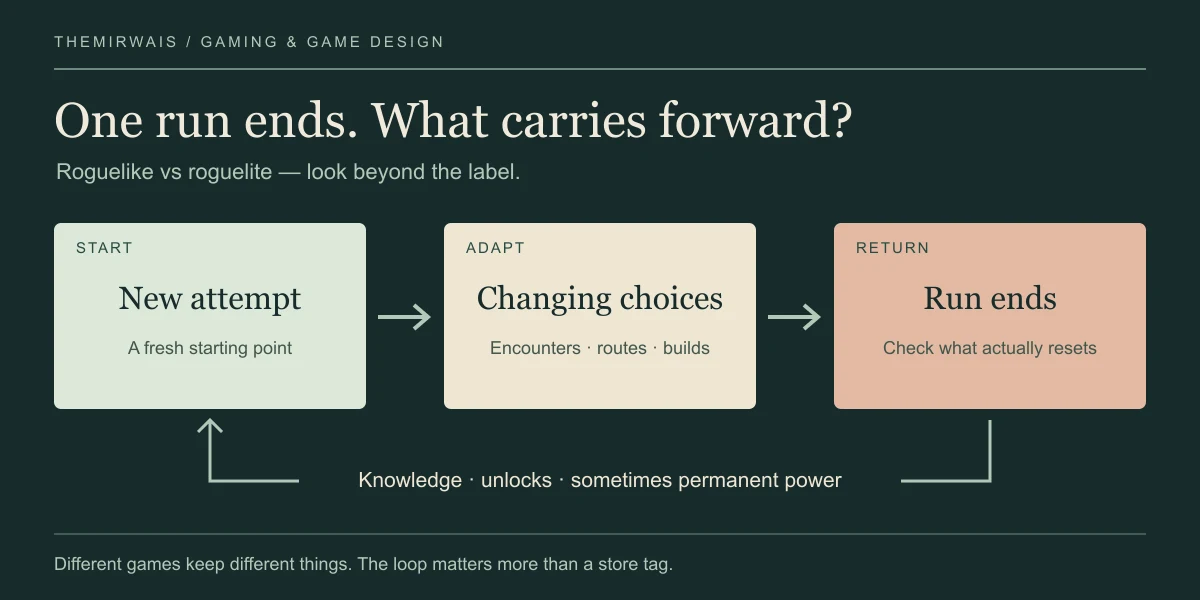
Two games promise that every attempt will be different. In one, a bad decision ends a character you have spent hours building. In the other, you return to a familiar hub, buy an upgrade and hear a new conversation before heading out again. Both might appear under the same store tag.
That is why the roguelike vs roguelite distinction can be frustrating when you are simply trying to choose something to play. The words suggest a clean dividing line. The games are messier, and often more interesting, than that.
A useful starting point: traditional roguelikes usually emphasise turn-based, grid-based dungeon exploration and the loss of a run. Roguelite is often used for games that borrow the repeated-run structure while changing the action, presentation or progression. Permanent upgrades are common in some of those games, but they are not a universal definition.
This guide explains the differences that affect your time with a game: what resets, what carries over, how decisions work and whether repetition feels worthwhile. The examples refer to the named games, not their sequels. Developer descriptions and documentation were checked on October 26, 2026; the recommendations are editorial suggestions rather than a ranking based on invented playtime or scores.
Roguelike vs roguelite at a glance
| Question | Traditional roguelike tendency | Common roguelite or hybrid approach |
|---|---|---|
| How do you act? | Turn-based choices on a spatial grid | Action, platforming, cards or another main system |
| What ends when you fail? | The current character or attempt | The current run, with game-specific exceptions |
| What remains? | Player knowledge, records and other game-dependent features | Knowledge plus possible unlocks, story or upgrades |
| What changes next time? | Dungeon layout, encounters, items and other conditions | A selection of rooms, rewards, routes or builds |
| Is permanent power required? | Usually not the central between-run loop | It may be important, modest or largely absent |
| Does the label tell you difficulty? | No | No |
Scroll the table sideways on a phone. These are useful tendencies, not an admission test. A turn-based card battler and a turn-based dungeon crawler can share a rhythm of planning while asking very different questions of the player.
Why the terminology refuses to stay tidy
The name points back to Rogue. Over time, developers borrowed different parts of that design tradition: uncertain environments, consequential failure, limited resources and repeated attempts. Borrowing those ideas did not require borrowing the same interface or combat.
One influential attempt to describe the traditional family is the Berlin Interpretation, produced at the International Roguelike Development Conference in 2008. Its preserved original text at RogueBasin includes turn-based play, a grid, generated environments and permadeath among its important factors. Its preamble also cautions against treating the factors as a simple checklist that conclusively includes or excludes a game.
Modern usage stretches further. Supergiant’s own Hades FAQ uses both terms and acknowledges the difference between the traditional turn-based format and its action-oriented approach. That is a good reason to read a game’s description past the tag.
For the broader background, my history of video-game genres and technology looks at how mechanics and platforms have changed together. Here, the important question is what the borrowed structure does to your next hour of play.
What actually resets after a failed run?
Imagine a fictional dungeon game. During an attempt, you collect a weapon, several temporary bonuses and some currency. When the attempt ends, the weapon and bonuses disappear. Some currency goes into a separate account that can be spent before the next attempt.
That example contains several systems which are often bundled into the word progress. Separating them makes the comparison much clearer.
Knowledge: the upgrade happens in your decisions
You learn an enemy’s warning animation, recognise a dangerous room or understand why a combination of items works. The next attempt can go better even if the character’s starting statistics are identical.
This kind of learning is easy to overlook because it has no purchase animation. Yet knowing when to leave a fight can matter more than a small damage increase. If the game is built around judgment, a failed attempt may still leave you better prepared.
Unlocks: more possibilities do not always mean more power
An unlock might add a character, weapon, card or route. It can broaden the decisions available without simply improving every future attempt.
Suppose the fictional game adds a slow weapon with a large reach. It may suit one player and frustrate another. Calling that unlock a permanent upgrade hides the tradeoff. The more useful question is whether the next run begins stronger, differently equipped, or merely with more possible discoveries.
Permanent power: the starting conditions improve
Now suppose the same game lets you buy extra starting health. That changes the baseline of later attempts. The player can improve through practice while the character also becomes more capable.
There is nothing inherently wrong with that design. It can create a satisfying long-term rhythm. But if you dislike repeating early encounters to afford the next improvement, look closely at how much of the game’s progression depends on those purchases.
Narrative progress: a return can move the story forward
A repeated location can change because characters react to what happened. You may fail the immediate objective while moving a relationship or another story thread forward.
That is a different reason to begin again. Someone who mainly wants a continuous campaign may still dislike the resets; someone who enjoys revisiting a cast of characters may find the return itself rewarding. Neither preference tells you how skilled that person is.
Why repeating a run can stay interesting
A changing map is only part of the appeal. If every new corridor leads to the same decision, different layouts can still feel repetitive.
What matters is how the conditions change your priorities. Perhaps a reward makes a previously weak card useful. Perhaps taking a dangerous route now improves your chances later. Perhaps the sensible move is to leave an attractive item behind because reaching it costs too much health.
These are choices about adaptation. A good comparison between games asks what you are adapting to: combat timing, resource scarcity, a changing deck, spatial hazards or a mixture.
Procedural generation does not mean every room is invented from nothing
Designers can combine authored pieces through rules. In a Spelunky 2 interview on PlayStation Blog, Derek Yu describes generating a path using room templates. Hand-authored structure and variation can work together.
The result is also different from generative AI producing a new world during play. A game can rearrange rooms, encounters or rewards through programmed rules without using a language model. The phrase procedurally generated does not, by itself, tell you the technology or how good the resulting levels will be.
A powerful build is interesting because you assembled it
Consider another fictional example: an item rewards frequent small attacks, while a second item gives those attacks a chance to trigger an effect. Together they change which weapon looks attractive. The excitement comes from recognising an interaction under the conditions of this attempt.
That is different from following a guaranteed equipment checklist. Guides can explain systems, but a fixed “best build” may be less useful when the available pieces change. Learning why a combination works is more portable than memorising the finished version.
Five games to consider, depending on what you enjoy
These are examples of different approaches, rather than an argument that every title belongs in one uncontested category. Check the current version and store page for your platform before buying, especially for controls, accessibility, saving and downloadable content.
| If you want… | Look at… | The tradeoff to consider |
|---|---|---|
| Real-time action with an ongoing cast and story | Hades | Reflex combat still matters |
| Turn-based deck decisions | Slay the Spire | Bad deck or route choices can end an attempt |
| Side-scrolling action and branching exploration | Dead Cells | Unlocks do not remove the execution challenge |
| Platforming built around interacting hazards | Spelunky 2 | Mistakes can unravel an attempt quickly |
| A traditional dungeon-crawling approach | Dungeon Crawl Stone Soup | A substantial set of systems and commands to learn |
Hades: action with a reason to return to the hub
Hades combines real-time combat with repeated escape attempts. Its persistent progression and character interactions make it a useful example of how a run’s ending can feed a longer story.
Consider it if action and an ongoing cast appeal to you. Be cautious if you mainly want uninterrupted story scenes or dislike repeating combat spaces. The story structure does not remove the need to learn the action.
Supergiant also documents God Mode, an option that increases resilience to damage. It is worth checking available assistance instead of assuming the only choices are to master the default difficulty or stop playing.
Slay the Spire: time to think, plenty to get wrong
The original Slay the Spire centres its run on building a deck and navigating encounters. Mega Crit’s store description describes changing routes, cards and relics between attempts.
It is a useful starting point if you enjoy considering a move rather than executing a dodge. That does not make it simple. A tempting card can make the deck less consistent; a route can ask more of your remaining health than you can afford.
The important contrast with an action game is the kind of pressure. You can inspect a decision, but you still have to live with it. Turn-based does not mean consequence-free, and a deckbuilder is not automatically a traditional grid-based roguelike because its combat uses turns.
Dead Cells: movement and execution stay central
Dead Cells describes itself as a roguelite action-platformer with branching exploration. Its publisher-authored store page explains that some progression remains between attempts, including access to paths and equipment possibilities.
Look at it if responsive movement, combat patterns and trying different weapons are the attraction. The promise of unlocks should not be mistaken for a relaxed pace. Your ability to handle encounters remains part of the challenge.
It also helps separate two ideas often merged in discussion: persistent progression and checkpoints within an attempt. A game can let some progress carry forward while still sending a failed run back to its beginning.
Spelunky 2: read the situation before rushing through it
Spelunky 2 uses a platforming vocabulary: movement, enemies, traps and changing level arrangements. The attraction is often the relationship between those elements, rather than a large menu of between-run stat purchases.
The original Spelunky introduction by its creator emphasises freedom, destructible levels and getting more skilled despite randomized layouts. The sequel extends that design family, rather than becoming a traditional turn-based dungeon crawler.
Consider it if careful observation and physical interactions sound appealing. Expect to learn from situations that go wrong. This is also why a strict “action game without a big upgrade tree equals traditional roguelike” rule is not particularly helpful: it misses what the game actually asks you to do.
Dungeon Crawl Stone Soup: explore the traditional side
Dungeon Crawl Stone Soup is an open-source dungeon adventure with a turn-based, spatial approach. You can take time to inspect a situation, but movement, positioning and resources still have consequences.
It is worth considering if you want to explore the traditional design rather than begin with an action hybrid. Expect a learning curve in its systems and interface. The project’s own manual covers commands, exploration, combat and saving; use documentation for the version you play.
The lack of a reflex deadline can make a game more comfortable for some players. It does not tell you how easy it will be to understand, or how forgiving a poor decision will prove.
How to choose a first game without buying the wrong kind of repetition
Start with the action you want to repeat. Would you rather dodge and strike, plan a sequence of cards, read a platforming room, or reason through a dungeon encounter? The answer narrows the choice more effectively than deciding which label is technically correct.
Then look at what you want between attempts. Some players enjoy a hub with upgrades and conversations. Others want to start again quickly with as little interruption as possible. A progression system that motivates one person can feel like an obligation to another.
Check the session rules separately from the run structure
“One run” is not a reliable unit of time. An early failure and a successful attempt can occupy very different parts of your evening. Do not assume that a game with repeated attempts is automatically suitable for a short break.
Check whether you can save or suspend an unfinished attempt, where that happens and whether the behavior differs by mode or platform. Saving between sessions is different from loading a checkpoint after a fatal mistake. Permadeath describes a consequence; it does not necessarily require finishing every attempt in one sitting.
Look for the options you will actually use
Inspect text size, remapping, visual effects, difficulty settings and any relevant accessibility information. A game’s genre tag tells you very little about these features. Watch ordinary gameplay, not only a trailer showing an exceptional late-game build.
Avoid treating assistance as a verdict on the value of your playthrough. Choosing a setting that lets you enjoy the decisions or story is a practical choice. Also avoid assuming that one game’s assistance options exist in another just because both are called roguelites.
If you discover that resets are the part you dislike most, there is no need to force the genre. My selection of role-playing games offers other ways to explore character building, tactical decisions and longer campaigns.
Make the next attempt a little more informative
An early goal need not be winning. Try noticing one decision you can explain afterwards: you entered a fight without an escape, added a card without considering its role, or chased a reward when resources were already low.
Those are possible explanations, not proof that every loss was avoidable. Randomness, unfamiliar information and execution errors can all contribute. Look for a change you can test next time instead of trying to turn every ending into a moral lesson about playing badly.
During the next attempt, change one thing. Use an escape option earlier. Read the enemy information. Leave a reward behind. Keep the experiment small enough to tell whether it helped.
Eventually, the useful question becomes less about whether the game is a “real” roguelike and more about whether you enjoy making those decisions again. The label can help you discover a game. The loop has to give you a reason to stay.
Books, videos, and further reading
The books below explore design, learning and procedural systems. Select Read More to open the Book and Author tabs; Buy opens the publisher’s page. Prices, editions and availability vary.
Books

Videos you can watch here
Open a play button to watch within the site. These talks and analyses discuss design decisions and include game footage; they may reveal mechanics or situations you would prefer to discover yourself. Version-specific details reflect their recording dates.
 How (and Why) Spelunky Makes its Own Levels — Game Maker's Toolkit
 Slay the Spire: Metrics Driven Design and Balance — GDC
 Breathing Life into Greek Myth: The Dialogue of 'Hades' — GDC
Developer pages and original sources
- Berlin Interpretation, preserved at RogueBasin — a historical description of traditional roguelike characteristics.
- Supergiant’s Hades FAQ — genre terminology, progression and difficulty options.
- Mega Crit’s Slay the Spire press kit — the developer’s description of its deckbuilding game.
- Dead Cells official site — its action-platforming approach and branching exploration.
- Derek Yu on Spelunky 2’s level generation — a developer interview about templates and variation.
- Dungeon Crawl Stone Soup — the official project and links to play, download and learn.